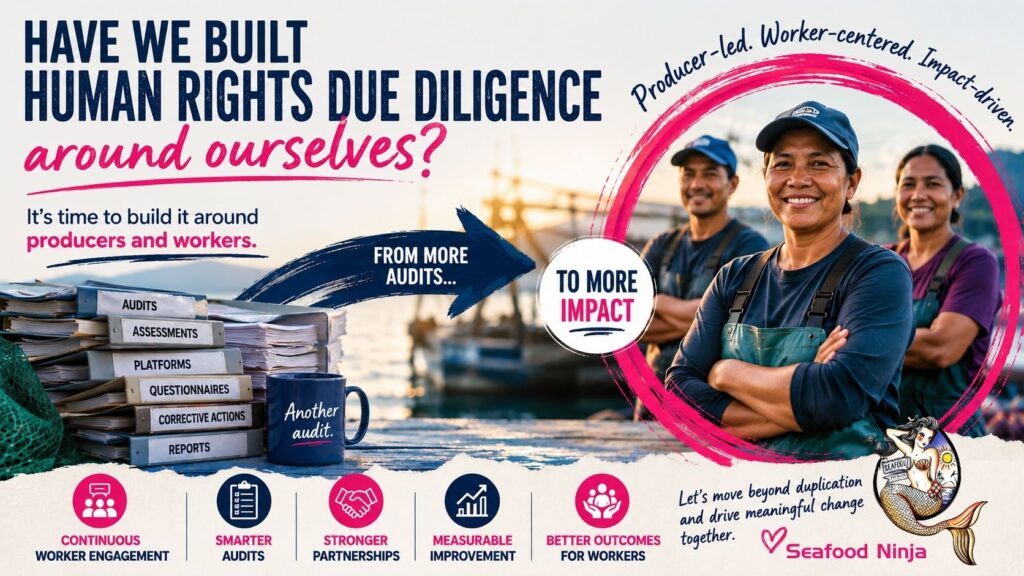
Have We Built Human Rights Due Diligence Around Producers—or Around Ourselves?
Over the past decade, significant resources have been invested in building the human rights due diligence ecosystem. In response to growing expectations from regulators, investors, retailers, NGOs, and civil society, companies now have access to audits, standards, certification programs, worker engagement platforms, grievance mechanisms, advisory services, training initiatives, risk assessment tools, and reporting frameworks designed to improve conditions for workers.
Many of these efforts have created real value and helped elevate labor rights within global seafood supply chains.
But after years of working directly with producers, importers, retailers, NGOs, and certification programs, I’ve started asking myself a difficult question:
Are we building systems that work for workers and producers, or systems that work for us?
Today, a producer supplying multiple customers may participate in SMETA audits, BSCI audits, retailer audits, certification audits, customer assessments, worker engagement programs, traceability initiatives, and an ever-growing list of ESG requirements.
Most producers continue to do what they’ve always done: respond to customer expectations and market requirements.
But among those of us working in sustainability, responsible sourcing, social compliance, and human rights due diligence, a different question is beginning to emerge.
As new frameworks, platforms, assessments, and initiatives continue to be layered onto existing systems, are we making the most effective use of resources to improve conditions for workers?
Or are we increasingly asking producers to participate in overlapping processes that consume time and money without proportionate gains in impact?
Too often, the same issues resurface under different audit protocols, generating new paperwork but not necessarily new solutions. If you’ve been around the seafood industry long enough, you’ve probably noticed the pattern. Right around SENA, another article, lawsuit, investigation, or report surfaces highlighting labor abuses somewhere in the global supply chain. The details may change, but the themes often sound familiar.
Which raises an uncomfortable question:
After years of increasing investment in audits, assessments, corrective action programs, worker engagement initiatives, certifications, and due diligence systems, are we addressing root causes effectively, or are we becoming increasingly effective at documenting the same problems?
At the same time, an entire ecosystem has emerged around human rights due diligence—frameworks, standards, platforms, assessments, verification programs, consulting services, implementation projects, worker engagement initiatives, and grant-funded programs.
Many of these efforts provide real value.
But as the ecosystem continues to grow, it is fair to ask whether growth in due diligence activity is translating into proportional improvements for workers.
Because ultimately, the goal was never to create more due diligence. The goal was to improve outcomes for workers.
That raises a couple of questions:
- What if some of the resources currently spent managing overlapping audits, assessments, corrective action plans, and reporting requirements were redirected toward continuous worker engagement, grievance mechanism strengthening, remediation, and long-term capacity building?
- What if corrective actions were actively supported and monitored throughout the year instead of revisited during the next audit cycle?
- What if workers, producers, buyers, NGOs, auditors, certification programs, and labor organizations aligned around a common objective: measurable improvements for workers rather than simply more evidence of due diligence?
And perhaps most importantly:
What would human rights due diligence look like if producers and workers helped design it from the beginning?
I don’t have all the answers. But I believe it’s time to test new approaches.
For years we’ve asked producers to participate in systems largely designed by others.
Maybe it’s time to build a system around what producers and workers actually need.
I’m exploring a producer-led human rights due diligence program designed to reduce audit duplication, strengthen worker engagement, improve corrective action follow-up, and create greater alignment between buyers.
Not another framework. Not another audit.
A practical test of whether the resources we’re already investing can generate greater impact when coordinated differently.
If you’re a producer, retailer, importer, NGO, certification body, worker engagement organization, labor group, or funder interested in helping move this conversation into action, I’d love to talk.